
Kling 4.0 vs 3.0: What Changed and What a Video Costs (Prices Read 16 Oct 2026)
Kling 4.0 launched on October 15, 2026 with 30s native generation, up to 10-bit HDR and up to 15 references per task, What changed from Kling 3.0, what is live since Oct 16, and which one to use.
Kling 4.0, Kuaishou's new video model, officially launched on 2026-10-15 with up to 30 seconds of native generation, 10-bit HDR output and deeper reference control — but its API is not open yet, and third-party platforms still list Kling 3.0 as their newest version. Every spec and price below was read on the source's own page on 2026-10-16; where a page doesn't state something, we say so instead of borrowing a number from elsewhere. This article covers what actually changed from 3.0, where you can run 4.0 today, and what a video costs in dollars.
Quick answers
- Launch date: Kling 4.0 went live on 2026-10-15, per Kling's launch reporting covered by Sina Tech; the lightweight Kling 4.0 Flash opened to small-scale testing earlier, on 2026-09-28 (both read 2026-10-16).
- The three headline changes: up to 30 seconds in one native generation (long takes), up to 10-bit HDR output with 4K / 1080p / 21:9 support, and reference control that accepts up to 15 reference-material combinations plus up to 10 keyframes in one task (guancha.cn; ZOL, read 2026-10-16).
- Can you use it today? On Kling's own app, yes. Via API, no — Kling's developer pricing page still lists only Kling 3.0 and 3.0 Turbo, and the launch coverage describes API access as "coming soon" for enterprise customers and developers (klingai.com/dev; Sina Tech, read 2026-10-16).
- What a video costs: the API bills per second — Kling 3.0 runs $0.084/s (720p, no audio) to $0.42/s (4K), so a 5-second 1080p clip with native audio costs $0.84 (klingai.com/dev, read 2026-10-16). 🔴 Kling 4.0 API pricing is not published yet.
- On aggregators: Viralance, Medeo and fal.ai all still list Kling 3.0 (and older) as their newest Kling — no 4.0 anywhere we checked (read 2026-10-15/16).
- Credits math: Kling's official policy prices credits at $1 = 66 credits, refunds failed generations, and expires purchase credits after 2 years (kling.ai/docs/point-policy, read 2026-10-16).
What is Kling 4.0?
Kling 4.0 is the fourth generation of Kuaishou's Kling video model family, released 2026-10-15 with a stated focus of "real, controllable, professional" output for high-motion, camera-movement-heavy work (Sina Tech, read 2026-10-16). The official homepage markets it as "All-New Kling 4.0 — You call the shots," promising "stable dynamic motions and an immersive audio-visual experience" — but the homepage itself publishes no dates, specs or prices (kling.ai, read 2026-10-16). The specs below come from launch-day reporting and Kling's own developer pages.
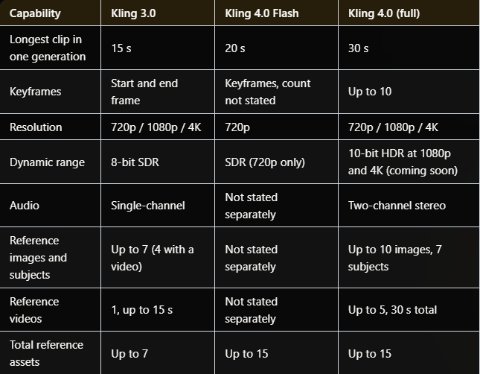
Kling 3.0 vs 4.0 Flash vs 4.0: what changed
The three versions get confused constantly, so here they are side by side. Flash is the lightweight build that opened small-scale testing on 2026-09-28, ahead of the full model (IT Home, read 2026-10-16); Kling has not published an itemized Flash-vs-full comparison, so that column stays deliberately thin.
| Capability | Kling 3.0 | Kling 4.0 Flash | Kling 4.0 (full) | What it means for you |
|---|---|---|---|---|
| Max native clip length | Already "breaks through duration limits" vs 2.6 (official 3.0 guide) | Not stated on the pages we read | Up to 30 seconds, long takes supported | One 30s take instead of stitching clips |
| Resolution / dynamic range | 4K available (API lists 4K tier) | Not stated | Up to 10-bit HDR; 4K, 1080p, 21:9 | HDR keeps highlight/shadow detail in night and neon scenes for grading |
| Audio | Native audio + lip-sync (3.0 series feature) | Not stated | High-quality audio, dual-channel stereo, improved lip-sync | Dialogue-grade sound without a separate pass |
| References / keyframes | Element consistency control (3.0 series feature) | Not stated | Up to 15 reference-material combinations; up to 10 keyframes | Lock faces, props and style across a whole sequence |
| Motion / camera | Stable for standard moves | Not stated | Optimized for high-speed motion and complex moves (push, pull, pan, tilt, track, follow) | Action and tracking shots hold together |
| Input caps | — | Not stated | Up to 10 images, 5 videos, 7 subjects per task (pre-launch official brief) | Multi-subject scenes in one generation |
| Agent access | — | — | MCP + CLI integration; AI agents can call 4.0 reference and keyframe features | Drive 4.0 from an agent workflow |
| API | Open (pricing published) | — | 🔴 Not yet open — "coming soon" for enterprise/developers | 4.0 is app-only until the API lands |
Sources for this table: kling.ai (read 2026-10-16); guancha.cn and ZOL launch reports (read 2026-10-16); app.klingai.com Kling 3.0 Omni guide (read 2026-10-16); klingai.com/dev (read 2026-10-16); IT Home pre-launch report (read 2026-10-16).
The honest summary: 4.0's jump is concentrated in duration (30 seconds native), HDR/ultrawide output, and reference control — while audio was already a 3.0-series feature, and Flash's positioning (fast and cheap, per its "lightweight" label) is not itemized anywhere official we could find.
Where you can run Kling 4.0 today (read 16 Oct 2026)
One day after launch, 4.0 lives on Kling's own platform — everywhere else we checked is still on 3.0 or older.
| Where | Kling 3.0 | Kling 4.0 | What you pay | Not stated on page | Source (read 2026-10-16) |
|---|---|---|---|---|---|
| Kling official app (kling.ai) | Listed in model docs | ✅ Live ("Create Now" / "Try Now" entry points) | Credits; $1 = 66 credits officially | Membership prices (page renders client-side); per-video credit cost shown at generation time | kling.ai; kling.ai/docs/point-policy |
| Kling API (klingai.com/dev) | ✅ Open — per-second pricing published | 🔴 Not listed; launch coverage says "coming soon" | 3.0: $0.084/s (720p, no audio) to $0.42/s (4K); 1 Unit = $0.14 list | 4.0 API pricing and date | klingai.com/dev |
| fal.ai | ✅ Listed (Kling 3.0) | 🔴 Not listed | Not stated on the model page (client-side) | Per-second price on page; 4.0 timeline | fal.ai |
| Viralance | ✅ Kling 2.5 Turbo Pro → 3.0 Pro / O3 Pro | 🔴 Not listed | One-time credit packs, $9 / 30 credits to $299 / 1,650 credits; e.g. Kling 3.0 Pro 5s = 10 credits ($1.81) | 4.0 timeline | viralance.com/pricing |
| Medeo | ✅ Kling 3.0 | 🔴 Not listed | Yearly-billed plans: Pro US$314, Insider US$912, Elite US$2,832 | Monthly prices (client-side); per-video cost | medeo.app |
| Replicate | Could not verify — model page not found today | — | — | Existence of current Kling listing | replicate.com |
Not stated = the page doesn't say, and we didn't borrow a number from elsewhere. Kling 4.0 availability moves fast; this row-by-row picture is one day post-launch.
The API is still on 3.0 — and that's where the public prices are
Kling's developer page publishes per-second API pricing in "Units," with 1 Unit = $0.14 list (klingai.com/dev, read 2026-10-16):
| Model / setting | 720p | 1080p | 4K |
|---|---|---|---|
| Kling 3.0, no native audio | $0.084/s | $0.112/s | $0.42/s |
| Kling 3.0, with native audio | $0.126/s | $0.168/s | $0.42/s |
| Kling 3.0 Turbo, with native audio | $0.112/s | $0.14/s | Not listed |
Do the multiplication yourself for a real clip: a 5-second 1080p Kling 3.0 video with native audio costs 5 × $0.168 = $0.84; the same at 4K costs 5 × $0.42 = $2.10 (arithmetic on the official rates above). 🔴 None of this pricing covers 4.0 yet — the dev page's video table has no 4.0 row, and Kling's launch statement describes API access as coming later for enterprise customers and developers.
Consumer plans: official page unreadable, secondary source dated
Kling's own pricing page renders client-side and showed no prices when we read it on 2026-10-16, so we will not invent membership numbers. What we can verify is the official credits policy: $1 = 66 credits, failed generations refund credits, purchase credits stay valid for 2 years, regular membership credits expire after 1 month, and daily login credits (subscribers only) reset at 24:00 (kling.ai/docs/point-policy, read 2026-10-16). A third-party guide that read Kling's membership and points pages on 2026-09-09 lists Standard at $8.80/month (660 credits), Pro at $32.56 (3,000), Premier at $80.96 (8,000) and Ultra at $159.99 (26,000) on renewal, with a free tier that carries a mandatory watermark and no 1080p/4K output — treat that as a secondary snapshot, not today's price (createvision.ai, read 2026-10-16).
Where Kling 3.0 still wins today
Price and access, not quality, are 3.0's remaining advantages. Every API platform we checked prices 3.0 publicly — Viralance sells Kling 3.0 Pro 5-second clips for 10 credits (≈$1.81 at its best-value pack rate) — while 4.0 has no published API price at all (viralance.com/pricing; klingai.com/dev, read 2026-10-15/16). If your pipeline runs through fal.ai, Replicate or an aggregator, 3.0 is the newest Kling you can call today (fal.ai; medeo.app; viralance.com, read 2026-10-15/16). And if 30-second HDR long takes aren't what your project needs, paying 4.0-era prices — once they exist — buys you little.
How to try Kling 4.0 today
- Open Kling's official app. Kling 4.0 is live there with "Create Now" / "Try Now" entry points on the homepage (kling.ai, read 2026-10-16); sign in and pick 4.0 in the model selector.
- Plan your inputs against the caps. Launch briefs put the single-task ceiling at up to 10 images, 5 videos and 7 subjects, with up to 15 reference-material combinations and 10 keyframes available (IT Home; ZOL, read 2026-10-16).
- Watch the credit cost before you generate. Credits deduct at generation and refund on failure, at the official rate of $1 = 66 credits — the per-video cost shows in the interface (kling.ai/docs/point-policy, read 2026-10-16).
- If you need API or batch work, stay on 3.0 for now. The published per-second rates are 3.0-only until Kling opens the 4.0 API (klingai.com/dev, read 2026-10-16).
- Draft on 3.0, finish on 4.0. Run composition and timing tests through the cheap 3.0 API tiers, then re-render the approved shots on 4.0 in the app for the 30-second HDR pass — the two share the same reference and keyframe concepts, so prompts transfer.
Where people will get stuck: assuming 4.0 is available everywhere because the launch was loud. A day in, it is official-app-only, and every aggregator we checked still tops out at 3.0 — check the model list on your platform before you plan a workflow around 4.0.
Create with Popliqo
Browse one-click video templatesFAQ
When did Kling 4.0 come out?
The full Kling 4.0 model launched on 2026-10-15, per launch coverage by Sina Tech; the lightweight Kling 4.0 Flash opened small-scale testing on 2026-09-28 (both read 2026-10-16).
Is Kling 4.0 free?
Kling's official credits policy describes no universal free tier — credits come from purchases, membership benefits or promotions, and failed generations refund (kling.ai/docs/point-policy, read 2026-10-16). A third-party guide reading Kling's pages on 2026-09-09 describes a free tier with a mandatory watermark and no 1080p/4K output; verify in-app before relying on it.
Is the Kling 4.0 API available?
No. Kling's developer pricing page lists only Kling 3.0 and 3.0 Turbo, and launch coverage says 4.0 API access is "coming soon" for enterprise customers and developers (klingai.com/dev; Sina Tech, read 2026-10-16).
What is the difference between Kling 4.0 and 3.0?
Duration and control: 4.0 generates up to 30 seconds natively, outputs up to 10-bit HDR with 4K/1080p/21:9 support, adds stereo audio with better lip-sync, and accepts up to 15 reference combinations plus 10 keyframes (guancha.cn; ZOL, read 2026-10-16). 3.0 already had native audio and element-consistency control (official 3.0 guide, read 2026-10-16).
How much does a Kling video cost?
Through the API, Kling 3.0 bills $0.084–$0.42 per second depending on resolution and audio — a 5-second 1080p clip with audio is $0.84 (klingai.com/dev, read 2026-10-16). Consumer use runs on credits at an official rate of $1 = 66 credits. 🔴 Kling 4.0 API pricing is not published yet.
Can I use Kling 4.0 on fal.ai, Replicate or other platforms?
Not as of 2026-10-16. fal.ai's model list, Viralance's pricing page and Medeo's model list all still top out at Kling 3.0 (or older), and Replicate's Kling page could not be found that day (all read 2026-10-15/16).
What is Kling 4.0 Flash?
The lightweight Kling 4.0 variant that opened small-scale testing on 2026-09-28, ahead of the full model (IT Home, read 2026-10-16). Kling has not published an itemized Flash-vs-full comparison, so treat "faster and cheaper" as positioning rather than documented spec.
Do Kling credits expire?
Yes, by type: purchased credits last 2 years, regular membership credits 1 month, 7-day membership credits 7 days, and daily login credits reset at 24:00 (kling.ai/docs/point-policy, read 2026-10-16).
The short version
Kling 4.0 launched on 2026-10-15 with 30-second native generation, up to 10-bit HDR (4K/1080p/21:9), stereo audio and up to 15 references plus 10 keyframes per task — but it is official-app-only for now: the API still prices Kling 3.0 at $0.084–$0.42 per second, and fal.ai, Viralance and Medeo all still list 3.0 as their newest Kling (all read 2026-10-16). Credits run at an official $1 = 66 with failed generations refunded. If your workflow needs API access today, draft on 3.0 and keep 4.0 for the final HDR pass in the app.
Sources
- kling.ai (read 2026-10-16)
- klingai.com/dev (read 2026-10-16)
- kling.ai/docs/point-policy (read 2026-10-16)
- fal.ai/models/fal-ai/kling-video/v3/pro (read 2026-10-16)
- app.klingai.com Kling 3.0 Omni model user guide (read 2026-10-16)
- guancha.cn/CaiJing/2026_10_16_904556.shtml (read 2026-10-16)
- ai.zol.com.cn/1260/12607971.html (read 2026-10-16)
- Sina Tech launch report via baijiahao.baidu.com (read 2026-10-16)
- IT Home pre-launch report via baijiahao.baidu.com (read 2026-10-16)
- createvision.ai/zh/guides/kling-ai-pricing-2026 (secondary source, read 2026-10-16)
- replicate.com (read 2026-10-16)
- viralance.com/pricing (read 2026-10-15)
- medeo.app model list and pricing (read 2026-10-15)